Evaluating an Advertising Media Planning Experience
Combining behavioral metrics and qualitative research to evaluate a media planning experience and establish a baseline for future measurement.
Role: Sole UX Researcher
Research: Evaluative / Benchmarking
Methods: 90-Minute Task-Based Evaluation · Qualitative Observation
Analysis: Task Success · Time on Task · CSAT · Qualitative Analysis
Participants: 13 advertisers
Platform: Zoom
Timeline: ~6 weeks
*Client, product, and specific research findings have been anonymized to protect confidential information.
01 – Challenge
An advertising platform needed to understand how advertisers experienced its media and reach planning workflow and establish a baseline for evaluating the experience over time.
The research centered on two related questions:
How effectively can advertisers complete key activities across the planning experience?
What factors influence their success or difficulty?
The study needed to provide both consistent measures of performance and satisfaction and qualitative context for interpreting those measures.
02 – Approach
After identifying the key activities with the client, I proposed a benchmarking protocol to evaluate them across the media planning experience. A standardized protocol allowed the team to measure the same activities consistently across participants and establish a baseline for future comparison.
Thirteen advertisers were recruited through the existing research panel to provide enough data to identify consistent performance patterns across the activities while keeping the study manageable within the project timeline.
Each session captured behavioral and experience data through observation and participant feedback, with task metrics calculated for each activity. CSAT was collected at the end of each session to measure overall experience satisfaction.
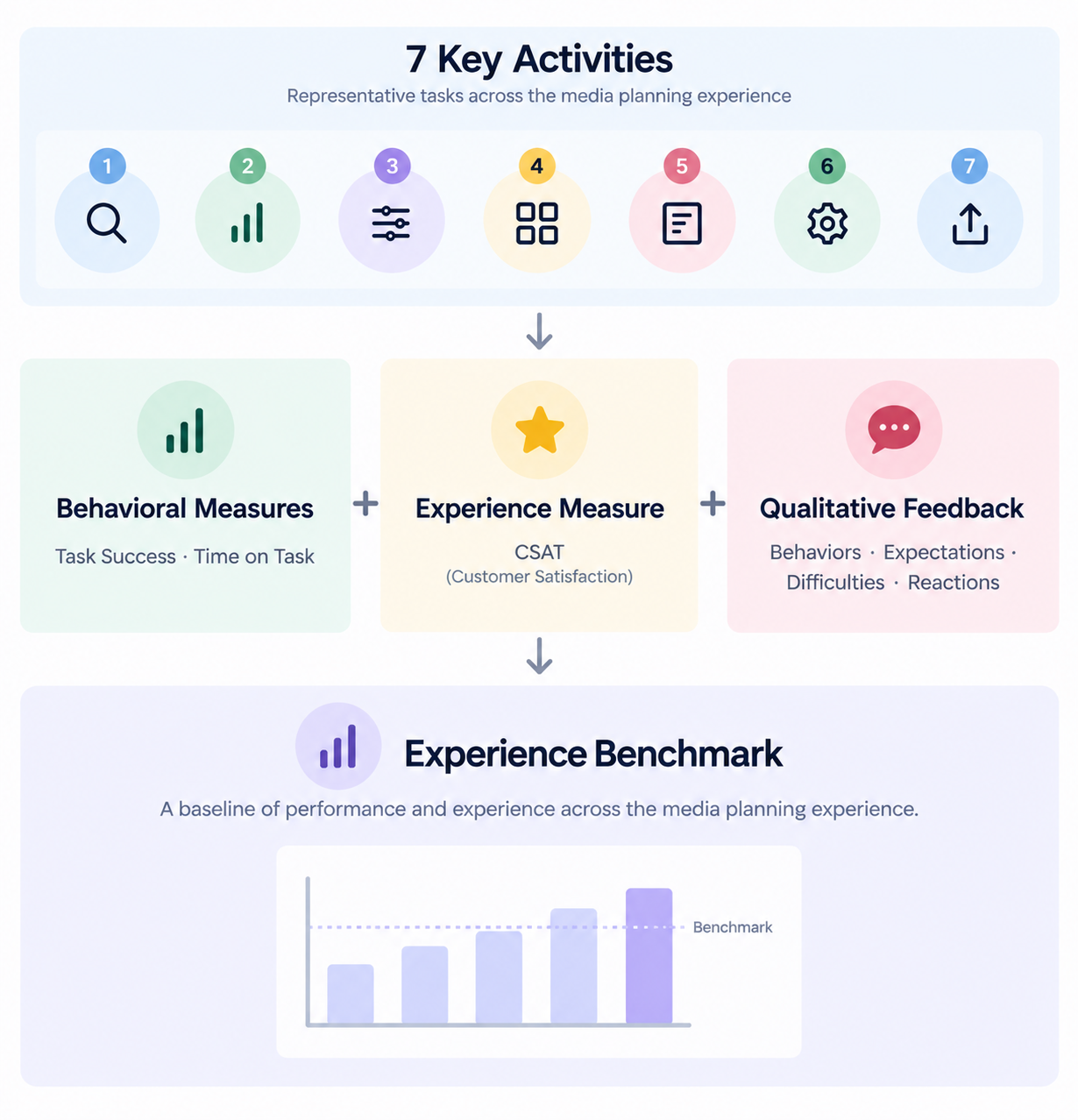
Using the same activities and measures across participants provided a consistent basis for comparison, while observation and follow-up questions helped explain the patterns behind the metrics.
03 – From Performance Data to Experience Insights
Quantitative task and satisfaction measures were analyzed alongside qualitative observations and participant feedback to build a more complete picture of the experience.
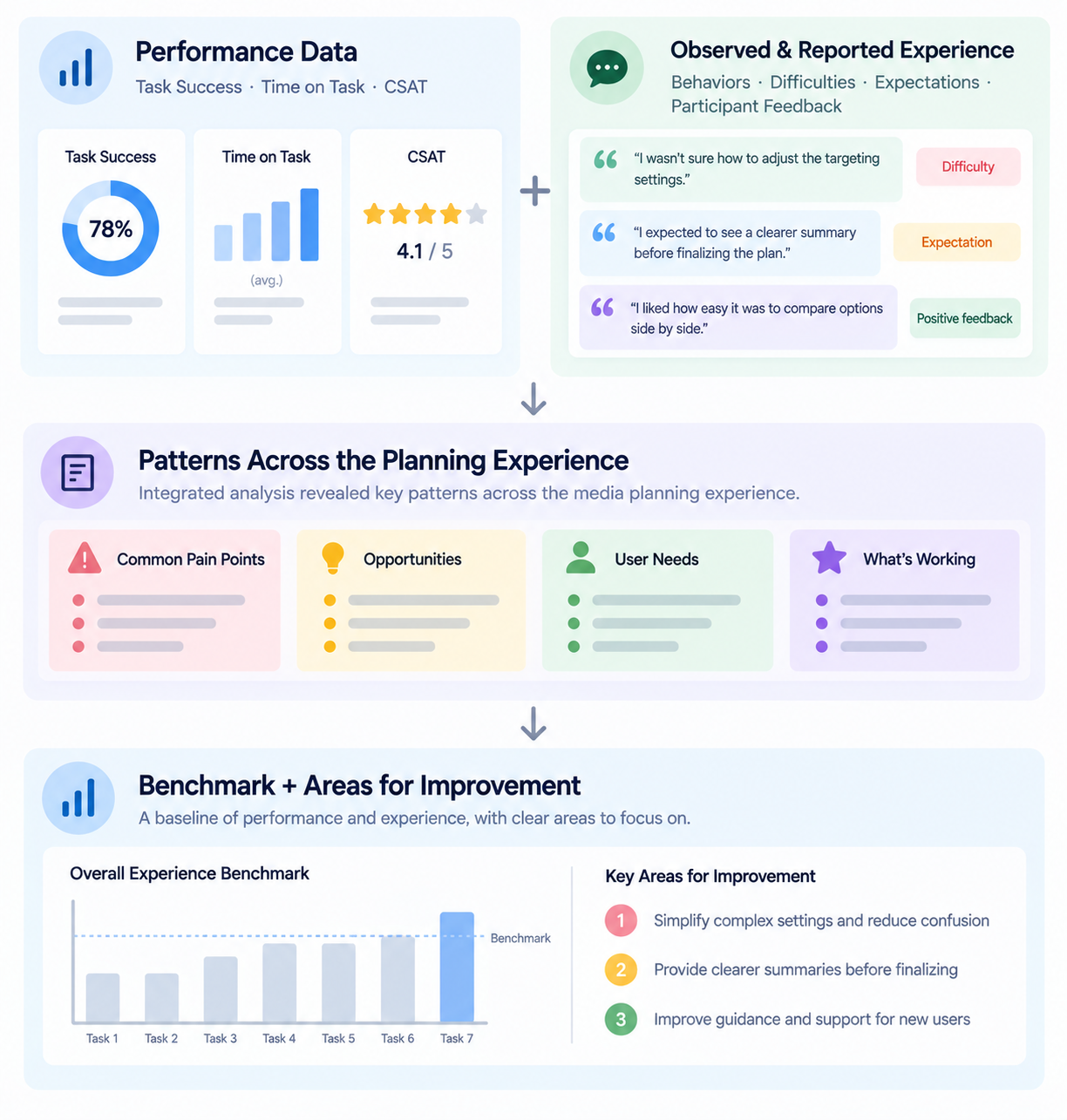
This allowed the research to identify not only where participants encountered difficulty, but also what was happening in the experience that contributed to those patterns.
04 – Outcome
The research established a baseline of the media planning experience, identifying patterns in performance and satisfaction across key parts of the workflow.
Combining behavioral metrics, satisfaction measures, and qualitative findings provided context for interpreting the benchmark and helped identify areas of the experience that warranted further investigation or improvement.
The benchmark also provided a foundation for evaluating the experience over time.
05 – Reflection
Account for the Research Environment When Interpreting Metrics
Because participants accessed the platform remotely by taking control of a research machine, the study environment did not always perfectly replicate their normal working conditions.
Occasional connection lag could affect interactions, making it difficult at times to distinguish product-related friction from remote-access latency. Participants joining from laptops could also experience the platform on a smaller screen than they typically used.
These factors were especially important in a benchmarking study because measures such as time on task and satisfaction could be influenced by the research environment itself.