Understanding the Impact of Game Design on Cognitive Skill Training
A mixed-method experimental study examining how game design elements influence adolescents’ motivation, game performance, and executive-function skill development.
Role: Primary Researcher
Research: Experimental / Mixed Methods
Frameworks: Self-Determination Theory · Cognitive Theories of Transfer
Methods: Experimental Design · Surveys · Semi-Structured Interviews
Analysis: ANCOVA · Moderator Analysis · Correlation Analysis · Qualitative Analysis
Participants: 142 secondary school students, primarily ages 12–14
01 – Research Challenge
Executive functions, including inhibition, shifting, and updating, support reasoning, planning, problem solving, and other cognitive processes. Games have shown potential as cognitive-training interventions, but less is understood about how individual game-design elements affect motivation and training outcomes, particularly among adolescents.
The study examined:
How do game design elements in a cognitive skills training game influence adolescents’ intrinsic motivation, in-game performance, and executive-function performance?
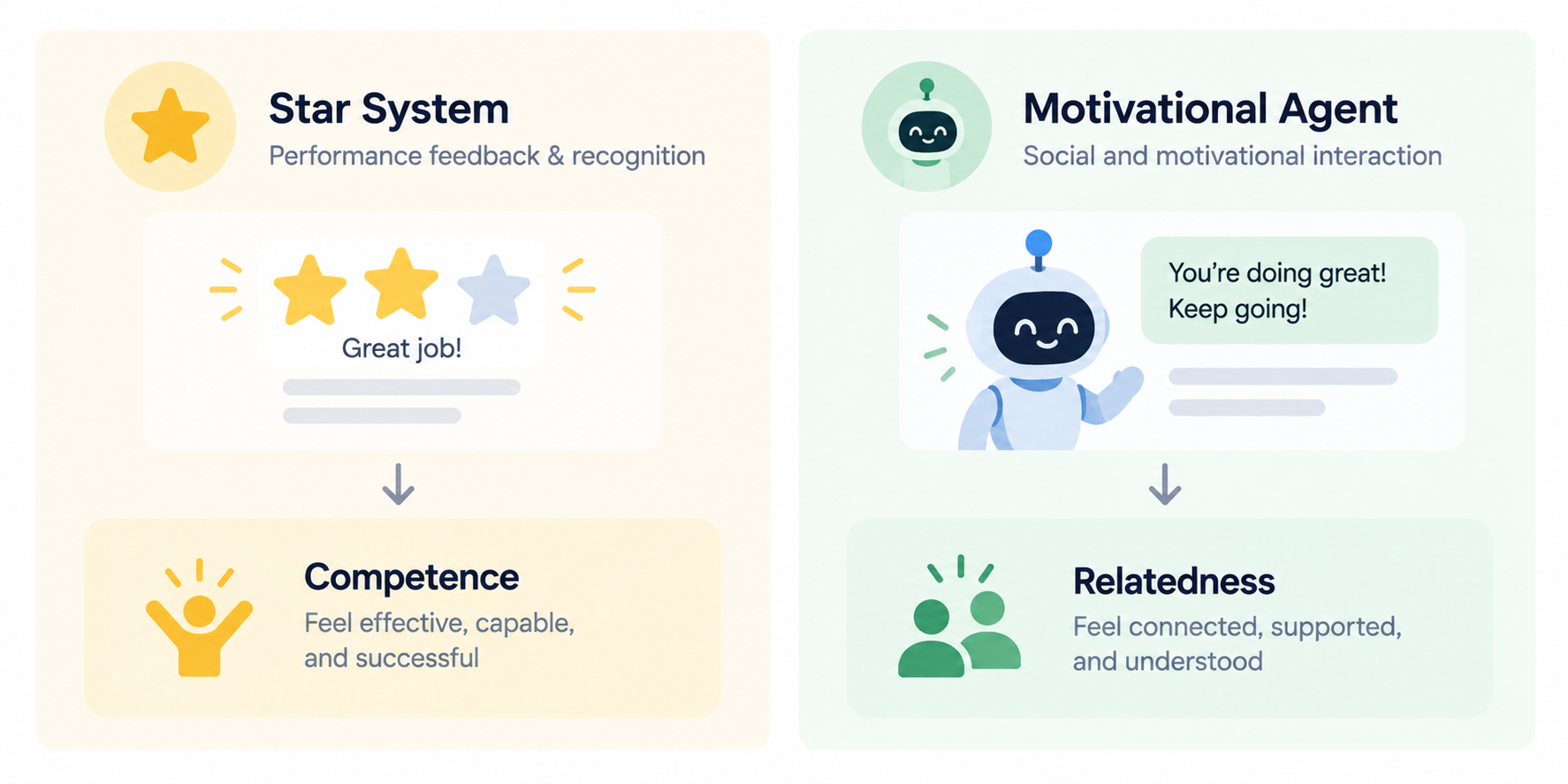
Two design elements were investigated: a star system providing performance feedback and achievement recognition, and a motivational agent designed to support motivation and engagement through social interaction.
02 – Theory-Informed Research Design
The Cognitive Training Game
The study used Gwakkamolé, a validated cognitive-skills training game designed to support executive-function development through gameplay. The game provided the core training experience, while the study experimentally manipulated two additional game-design elements.
Connecting Design Elements to Psychological Needs
Self-Determination Theory provided a framework for hypothesizing how game design might influence intrinsic motivation through the psychological needs for autonomy, competence, and relatedness.
The two design elements were connected to different needs:
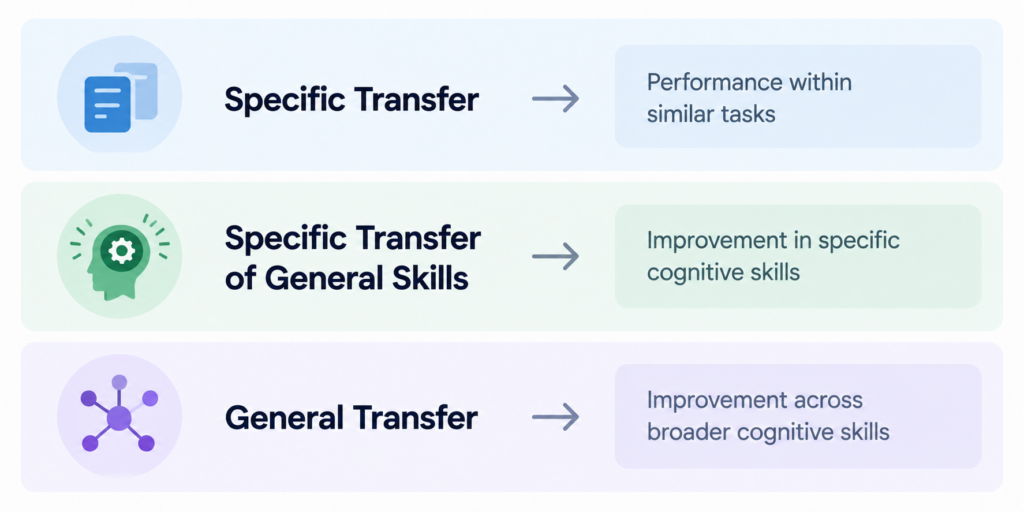
The study also drew on Cognitive Theories of Transfer to distinguish whether learning effects remained within the game or transferred to broader cognitive tasks:
03 – Experimental Design
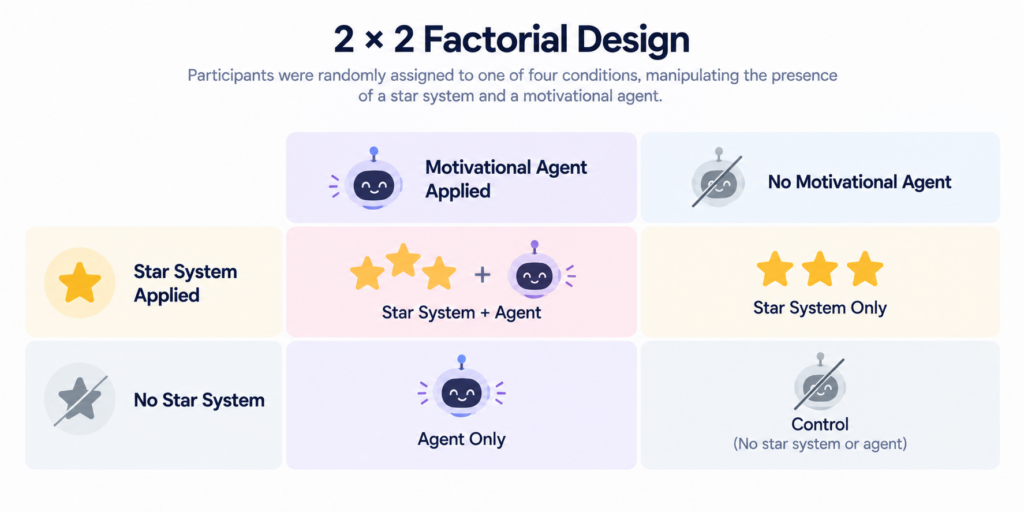
A pretest-posttest 2 × 2 factorial design was used to isolate the effects of the two game-design elements.
The target sample size was determined based on effect sizes reported in similar studies and a priori power analysis, ensuring the study had sufficient statistical power to detect meaningful effects of the game-design elements.
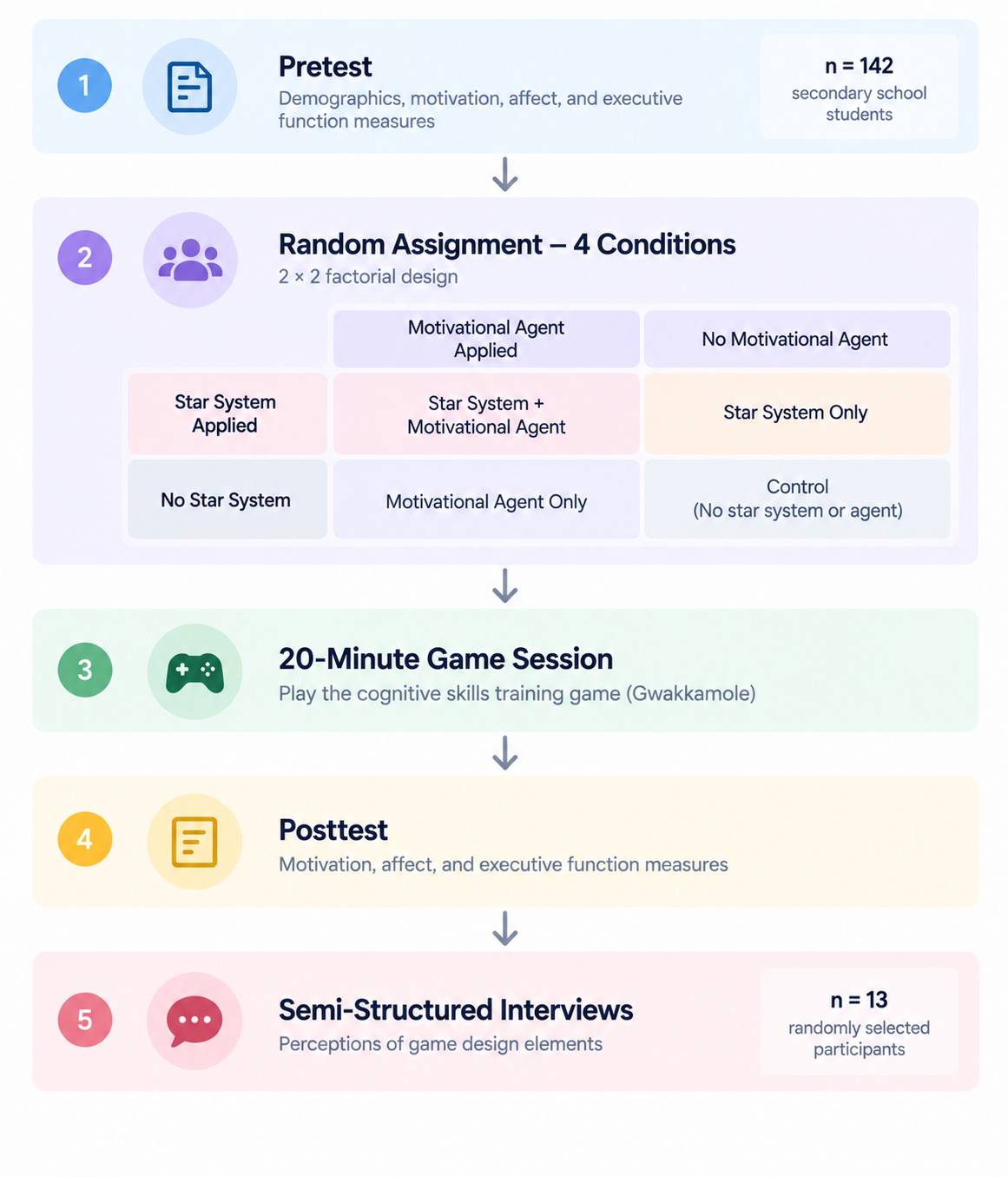
A total of 142 participants were randomly assigned across the four conditions: 36 received both elements, 36 the star system only, 36 the motivational agent only, and 34 received neither.
Participants completed pre-experiment measures, a 20-minute cognitive-training game session, and post-experiment measures. A randomly selected subset of 13 participants then completed 10-minute semi-structured interviews about their perceptions of the game-design elements.
04 – Measuring Motivation, Performance & Transfer
The study combined in-game performance, motivation, executive-function, and qualitative measures to examine how the design elements affected different aspects of the experience.
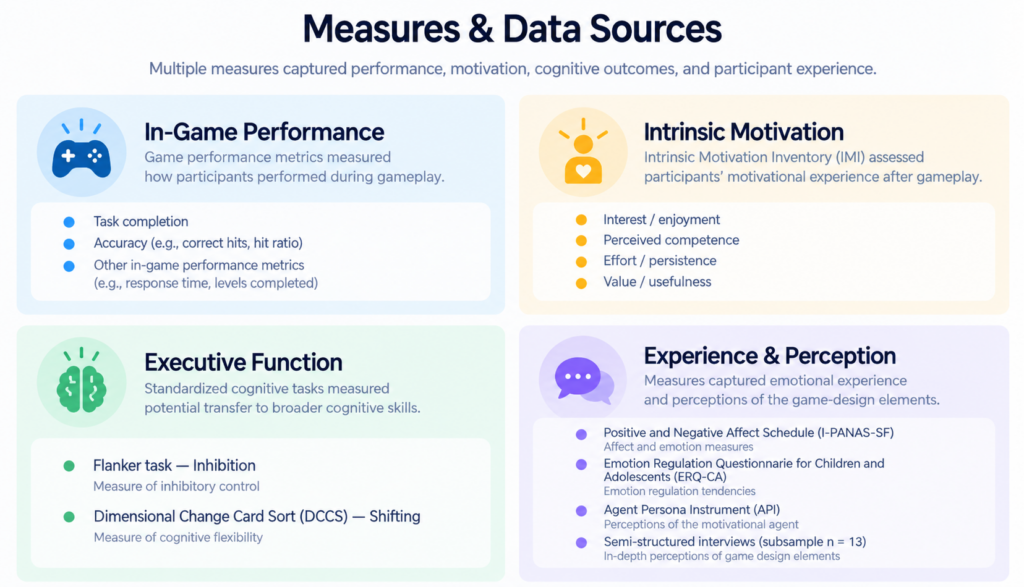
Together, these measures captured both immediate effects within the game and potential effects beyond the game, while the qualitative data provided context for how participants experienced the design elements.
Statistical analyses included ANCOVA, moderator analysis, t-tests, and correlation analysis, with qualitative interviews adding context to participants’ perceptions of the design elements.
05 – Key Findings
Game Design Influenced Performance But Not in the Same Way Across Outcomes
The cognitive-training game itself was associated with a statistically significant improvement in participants’ inhibition-task performance from pretest to posttest.
The star system had a significant positive effect on in-game performance, including correct-hit and hit ratios. The motivational agent did not show a significant effect on these performance measures.
However, neither the star system nor motivational agent produced statistically significant improvements in the measured executive-function outcomes or intrinsic motivation. The study therefore suggested that a design element can influence performance within a game without necessarily producing broader cognitive transfer or greater intrinsic motivation.
06 – Implications for Design
The results highlight the importance of examining game-design elements individually rather than assuming that features commonly associated with engagement will automatically improve motivation or learning outcomes.
The star system was perceived as useful for communicating performance and establishing clear goals, but the findings also raised questions about the design of feedback, including whether it is experienced as informational or evaluative.
The mixed perceptions of the motivational agent similarly suggested that simply adding a social or motivational character may not be sufficient; how messages are delivered and how users perceive the agent can influence the experience.
07 – Reflection
The intervention consisted of a single 20-minute training session, and executive-function outcomes were measured only immediately afterward. The design also examined competence- and relatedness-supportive elements but did not include an autonomy-supportive element.
For future research, longer and repeated training sessions, delayed measurement, and a broader range of motivational design elements would provide a stronger test of whether effects observed within the game eventually transfer to broader cognitive outcomes.